

Casino KYC Issues Explained
Three days into a withdrawal. ID uploaded twice. Status still shows “casino verification pending.” This is the part of online gambling nobody mentions in the bonus banners, and from a player’s perspective, it’s where most disputes actually start.
I write reviews for Gamble Critic, and the single biggest source of player complaints I see has almost nothing to do with bonus terms or RTP. It’s verification. A blocked payout after KYC review can sit for two days, a week, sometimes longer, and the player has no clear way to tell whether the casino is processing the file in good faith or stalling.
Let me walk through what actually happens behind that “pending” status.
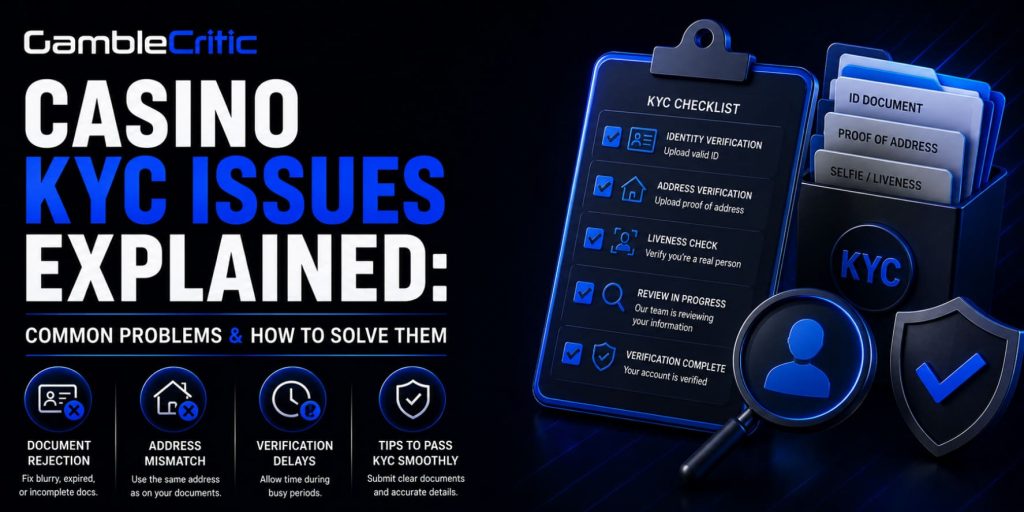
What is KYC?
Know Your Customer. That’s the phrase behind KYC, and it predates online gambling by decades. Banking compliance teams were running KYC checks long before anyone streamed a live blackjack table. Every licensed casino site sits under the same legal umbrella, because the regulator that issued the license also dictates the anti money laundering checks the operator has to run. Malta Gaming Authority sets one baseline. UK Gambling Commission sets a stricter one. Gibraltar, Isle of Man, Kahnawake (KGC), and Curacao each have their own floor too. Different paperwork, same idea: the casino has to prove you are the actual person behind the account before money leaves the cashier.
How casino KYC works in practice is layered. The first tier is basic identity: a government ID and a selfie. The second tier is residence verification, usually a utility bill, a bank statement, or a council tax letter. A third tier kicks in for larger amounts. This is the one most players don’t expect: source of funds. If you withdraw something like €5,000, expect questions about where that money came from. Payslips. Savings statements. Occasionally an employment letter.
The NV casino verification process runs on the same tiered model. Identity comes first. Address proof second, with the document age usually capped at 90 days. Source of funds enters the picture only on bigger payouts, and the exact threshold depends on the operator and the player’s region.
Why Casinos Request Documents?
The shortest answer: because regulators require it. The longer answer matters more if you’re trying to figure out why a particular request feels excessive.
Document requests usually trace back to one of several distinct triggers, and the pattern of what they ask for often tells you which one fired:
- Anti money laundering checks. Deposits that look unusual (large round numbers, sudden spikes, mismatched payment sources) escalate the file. This is automatic, not personal.
- Age verification. Required in every regulated market. Some casinos do this at signup, others delay it until withdrawal, and the second approach is a red flag in my view.
- Geographic restrictions. If a casino doesn’t accept players from a specific country or state, IP plus document review confirms eligibility.
- Self-exclusion register checks. UK casinos check GAMSTOP. Denmark uses ROFUS. Germany runs OASIS. A failed cross-check can void winnings entirely.
- Payment method ownership. When you deposit with a card, the casino wants proof the card belongs to you (front and back photos, with middle digits and CVV masked).
A casino asking for documents withdrawal side, but not deposit-side, is doing the legal minimum and not much more. The better operators front-load verification at registration, which means when you do hit a win, the payout actually moves on time.
Common Rejection Reasons
This is where most casino KYC pending tickets actually live. Not at the casino’s end. At the document quality end.
In my experience reviewing player disputes and operator complaint logs, the rejection reasons cluster into a small number of repeat offenders:
- Document edges cut off. All four corners of the ID need to be visible. A passport photo with one edge clipped gets bounced automatically, often by an OCR system before a human even looks at it.
- Glare or shadows. Phone flash on a glossy ID card washes out the photo or the document number. The single most common reason I see for a re-upload request.
- Expired ID. Sounds obvious. People forget. If your passport expired six weeks before the withdrawal request, the casino cannot accept it, even when you’re clearly the same person.
- Utility bill older than 90 days. Most operators set 90 days as the hard cutoff. Some allow 60. A March bill submitted in October won’t pass, and pleading the case to support rarely changes that.
- Address mismatch. The address on your account, on your utility bill, and on your bank statement all need to match. Players who recently moved get caught here constantly.
- Name mismatch. If you registered with your maiden name and your utility bill shows your married name, that is a flag. The workaround is straightforward: submit a marriage certificate as a supplementary document and reference it in the support ticket.
- Wrong payment method submitted. You deposited with Skrill, you’re withdrawing to a Visa card you also have on file, and the casino wants proof of both. Players who skip the second proof get stuck.
- Screenshots instead of statements. A photo of your banking app rarely passes. A downloaded PDF statement from your bank does. The difference comes down to metadata and document integrity, and OCR systems weight that heavily.
A delayed withdrawal approval after multiple resubmissions almost always traces back to one of these, not to malice on the operator’s part. Casino withdrawal delays of more than a week, however, are a different conversation.
How to Pass Verification?
Before claiming any bonus or making a large deposit, I would do verification upfront. Most casinos let you submit documents at any point in the account lifecycle, and getting them approved before you win removes friction at the worst possible moment.
A working pre deposit checklist:
- Use a color scan or high resolution phone photo, not a black and white printout. OCR engines need contrast and detail.
- Place the ID on a dark, flat surface without using flash. Daylight near a window works better than direct indoor lighting.
- Confirm all four corners are visible. No fingers covering the document number, no thumb over the date of birth.
- For the selfie step, hold the ID next to your face. Some casinos want a handwritten note with the current date and the casino name visible in the same photo – read the upload instructions carefully before submitting.
- For proof of address, use a PDF bank statement downloaded directly from your bank. If you have to use a utility bill, the issue date must be within 90 days.
- Match deposit and withdrawal methods where possible. Depositing with a card and trying to withdraw to a different e-wallet account triggers additional checks and slows everything down.
- For larger amounts, prepare source-of-funds documentation in advance. A payslip plus a recent savings statement covers most operator requests at the entry level.
If documents have been pending more than 72 working hours, contact support and ask which specific document failed and why. A polite, specific question usually gets a useful answer. A frustrated demand usually does not.
What separates a fair operator from a stalling one is response time and transparency in this exact window. Licensed casinos under MGA or UKGC have to respond to formal complaints within set timeframes, and they have an alternative dispute resolution (ADR) body you can escalate to, like IBAS in the UK or eCOGRA for several international operators. Curaçao-licensed sites have weaker enforcement on this, which is part of why blocked payouts after verification cluster on those operators in player forums.
If a casino keeps requesting new documents in cycles (passport, then proof of address, then payment method, then a selfie, then a different bill), without paying anything out in between, that’s a delay tactic. Safe withdrawal verification has a defined endpoint. Endless verification does not.
FAQ
How long does casino KYC take?
24 to 72 hours at most well-run operators once correct documents are submitted. Some are faster. A few are slower. Past 5 business days with no clear answer, escalate to support and ask for the specific reason in writing.
Do I have to verify before depositing?
Not always. UK-licensed casinos must verify before any real money play (this changed in 2019 under the UKGC’s rules). Operators under other licenses often let you play first and verify at withdrawal. The first model is significantly better for the player.
Why does the casino want my source of funds?
Because the regulator says so above certain thresholds. It is not a guess about whether you can afford to gamble. It is a paper trail for the money itself.
Can the casino keep my money if I fail verification?
In most jurisdictions, yes, if you provided false information at registration. If your documents are real and you genuinely are the registered player, the casino must return at least your deposits. Winnings are a separate question and depend on the terms you agreed to.
My utility bills are not in my name. What do I do?
Bank statement, council tax bill, government correspondence, or insurance documentation can substitute. Mobile phone bills are accepted by some operators and rejected by others, so check the upload page wording before submitting anything.
Can I withdraw to a different payment method than I deposited with?
Sometimes. Most operators require you to withdraw at least the deposited amount back to the original method first, then route any remaining winnings elsewhere. Card only deposits with e-wallet withdrawal requests usually need separate verification of both sides.
Is KYC the same at every casino?
No. The legal floor is set by the license, but operator policy adds layers on top of that. A casino under the same license can have stricter or looser document requirements than its direct competitor, and this is one of the reasons I weight payout speed and verification process heavily in reviews. Bonus headlines come second.




Reviews